

In 2026, volatility is the only constant. Economic shifts arrive without warning. Supply chains break. Customer priorities change faster than quarterly updates can capture. For any leader trying to navigate these turbulent markets, the old way of working simply doesn’t work anymore.
Yet many organisations are still relying on them. They wait for surveys to close, reports to compile, and insights to bubble up through layers of analysis. By the time these reports land on a desk, the moment has passed. Markets have moved. Competitors have already acted. Customers have already left.
There’s a better way. It’s called predictive intelligence, and it’s becoming the baseline for competitive advantage.
The Shift from Reactive to Predictive
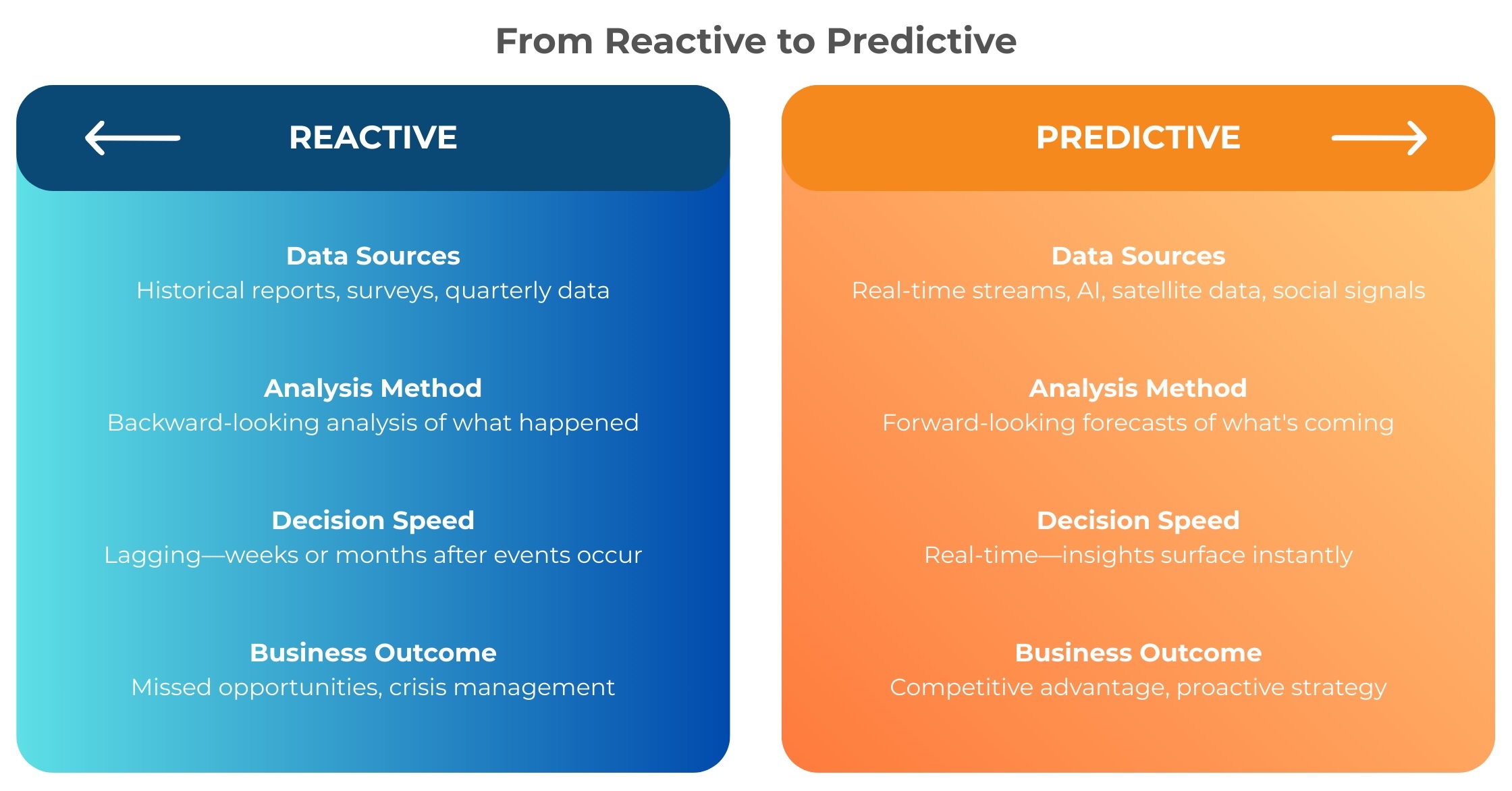
The transition is fundamental. Instead of asking “what happened last quarter?”, organisations are now asking “what’s about to happen tomorrow?” Instead of responding to crises after they hit, they’re preventing them before they form. Instead of chasing customer defection with retention campaigns, they’re spotting at-risk customers before a single one walks out the door.
This is already happening. Retailers are using predictive analytics to forecast customer behaviour, optimise inventory, and reduce churn by 20 to 30 percent. Financial institutions are adjusting strategies before economic trends shift, not after. Manufacturers are predicting equipment failures before breakdowns happen, saving millions in downtime.
What powers this shift is the combination of artificial intelligence, machine learning, and real-time data processing. At their core are platforms that integrate data, algorithms, and decision-making at scale. The result is organisations that can process vast amounts of information instantly, turning raw signals into actionable intelligence faster than competitors can even perceive the change.
The pace is accelerating. Deloitte’s 2026 State of AI notes that worker access to AI surged 50 percent in 2025, with companies scaling AI projects forecasted to double in the next six months. According to Forrester, 78 percent of enterprises will be deploying AI in business intelligence by 2026. The gap between those moving fast and those standing still is widening rapidly.
Why Traditional Methods Lag
Legacy research cycles were built for a different era. Quarterly reports and annual planning made sense when change happened slowly and you had time to adjust. That era is gone.
The problem is simple. Traditional approaches can’t keep pace with the speed and complexity of modern markets. A competitor launches a product. Social media sentiment shifts. A regulatory change reshapes your operating environment. By the time a traditional analysis captures these signals, synthesises them, and surfaces them to decision-makers, the window to act has closed.
Predictive systems work at a different pace. They process unstructured data continuously. Satellite imagery. Transaction patterns. Social listening. Supply chain signals. Weather data. Geopolitical news. Customer behaviour signals. They synthesise it all in real time, surfacing alerts and insights at the speed information arrives.
New technologies are accelerating this further. Specialised AI chips are emerging for these workloads. Agentic AI capabilities allow systems not just to predict but to recommend and act autonomously. The result is a fundamental shift in how intelligence flows through organisations.
The Real Business Impact
When predictive intelligence works, the results are tangible. Faster decisions mean faster market response. That translates to better inventory positioning, smarter capital allocation, and less waste. Predictive analytics can optimise marketing spend by up to 73 percent, fundamentally reshaping how budgets get deployed.
Risk reduction matters equally. By identifying threats early, organisations avoid costly mistakes. They enter new markets better prepared. They spot supply chain vulnerabilities before they become operational crises. They anticipate talent gaps before they threaten execution.
Competitive advantage compounds over time. Gartner predicts that by 2028, 90 percent of B2B buying will be AI-intermediated. Speed and intelligence become the primary differentiators. The organisations that anticipate win. The ones that react fall behind.
But success requires more than technology. The firms seeing the biggest impact combine predictive capabilities with strong data literacy across teams and thoughtful governance around how insights are used. Without these elements, data overwhelms rather than clarifies.
Africa’s Unique Position
Here’s where Africa’s story becomes particularly compelling. Many African organisations face an advantage that sounds counterintuitive. They don’t have decades of legacy systems to untangle.
Without the infrastructure burden of older technology stacks, African companies can leapfrog directly to modern predictive intelligence. They don’t need to rip out and replace legacy systems. They can build modern analytics capabilities from the ground up, purpose-built for African market realities.
The foundation for this is stronger than you might expect. According to BCG’s 2026 AI Radar, 59 percent of African companies are planning AI investments exceeding $50 million this year. Fifty-five percent of African workers are already upskilled in AI, matching global benchmarks. At least 15 African countries have government-backed AI strategies.
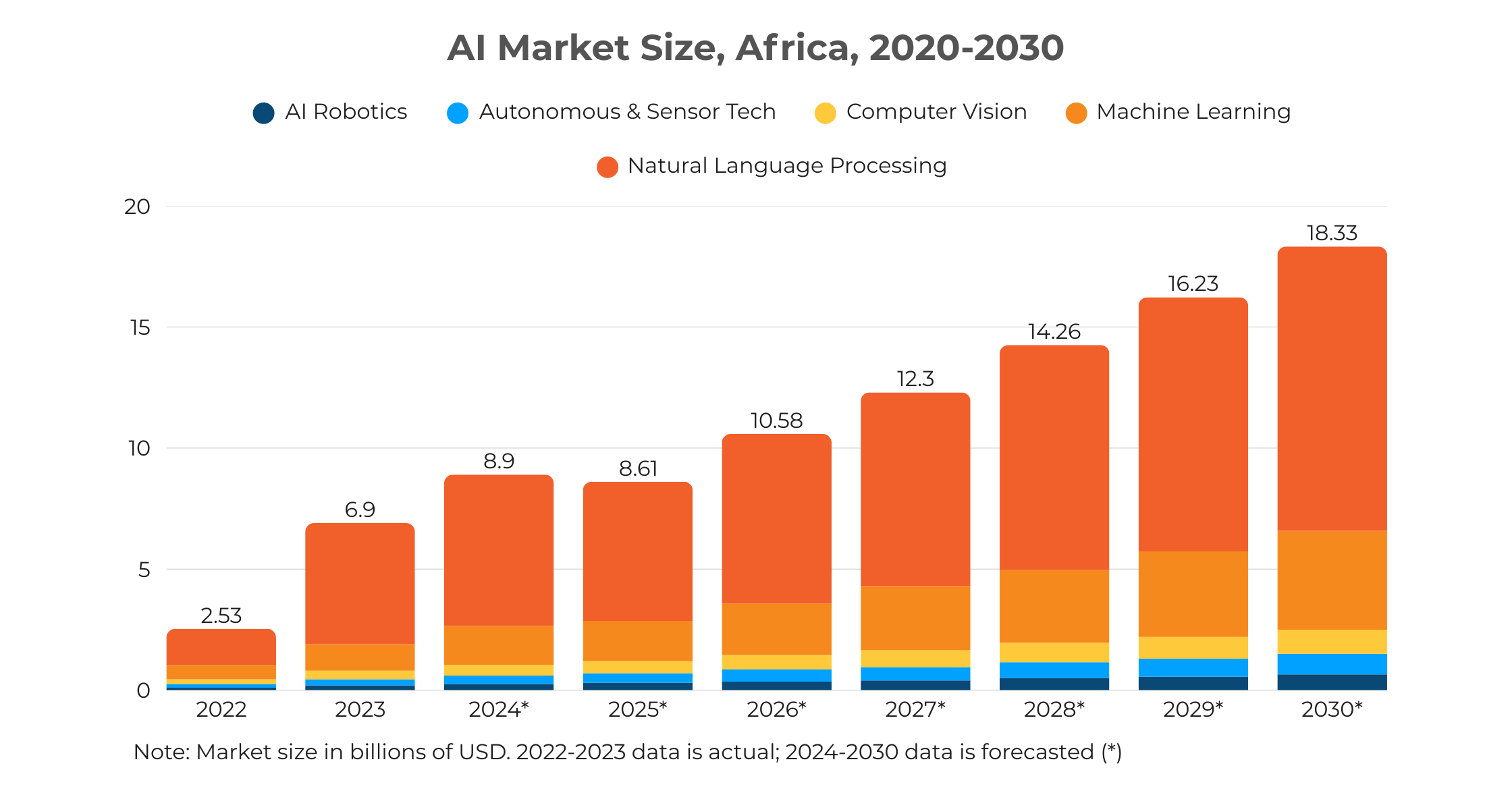
The economic potential is significant. The AI market in Africa is projected to grow substantially through 2030, with estimates suggesting AI could add as much as $1 trillion to continental GDP by 2035 through productivity gains and inclusive transformation. As shown in the Brookings data, machine learning and natural language processing are the fastest-growing segments, driving expansion across sectors like consumer retail, agriculture, manufacturing, and financial services. Generative AI alone could unlock approximately $100 billion in value, potentially doubling GDP growth rates across the region.
The challenges are real and specific. Language diversity. Informal economies. Data scarcity in certain sectors. But these aren’t blockers. They’re opportunities for tailored solutions. Organisations building predictive models designed for African contexts, whether in agriculture, mobile money, supply chains, or healthcare, are creating competitive advantages that deepen as they scale.
The winners in Africa in 2026 aren’t waiting for perfect data or global blueprints. They’re building solutions that work for local realities. They’re using predictive intelligence to anticipate customer needs in informal markets, optimise supply chains across fragmented networks, and deploy capital where it’s most likely to deliver impact.
What Comes Next
As predictive intelligence becomes the standard for competitive advantage, organisations face a clear choice. Build capability now, or risk irrelevance as peers move ahead.
Start by auditing where your organisation is making decisions. Where are you moving slowly? Where do you act on incomplete information? Where would earlier warning signals change your strategy? These are your entry points.
Then build capability deliberately. Invest in talent, platforms, and governance together. Predictive intelligence only delivers value when teams know how to interpret insights and when you have guardrails around how they’re used.
Partner strategically. You don’t need to build everything in-house. Work with advisors and partners that understand your market and can help you move at speed.
Most importantly, start now. The cost of waiting exceeds the cost of experimentation. The organisations that will lead in the next few years are those already building these capabilities today.
The Future Belongs to Those Who Anticipate
The future of intelligence isn’t about having more data. It’s about turning data into foresight faster than competitors can. It’s about seeing around corners and moving proactively rather than reactively. It’s about building organisations that are genuinely adaptive in how they operate, not just in what they say.
Predictive intelligence makes that possible. In Africa, in particular, the window to build this capability and use it as a genuine competitive advantage is open now. The organisations that move will lead.
At IOA, we’re closely monitoring these developments in advanced analytics and market intelligence to support leaders in navigating what’s next. If you’re thinking about how predictive intelligence might strengthen your decision-making, we’re here to help you explore what’s possible.